
Where Security Cameras Belong — and Don’t — in Healthcare Facilities

Charlie Ragghianti
15 Jul 2026


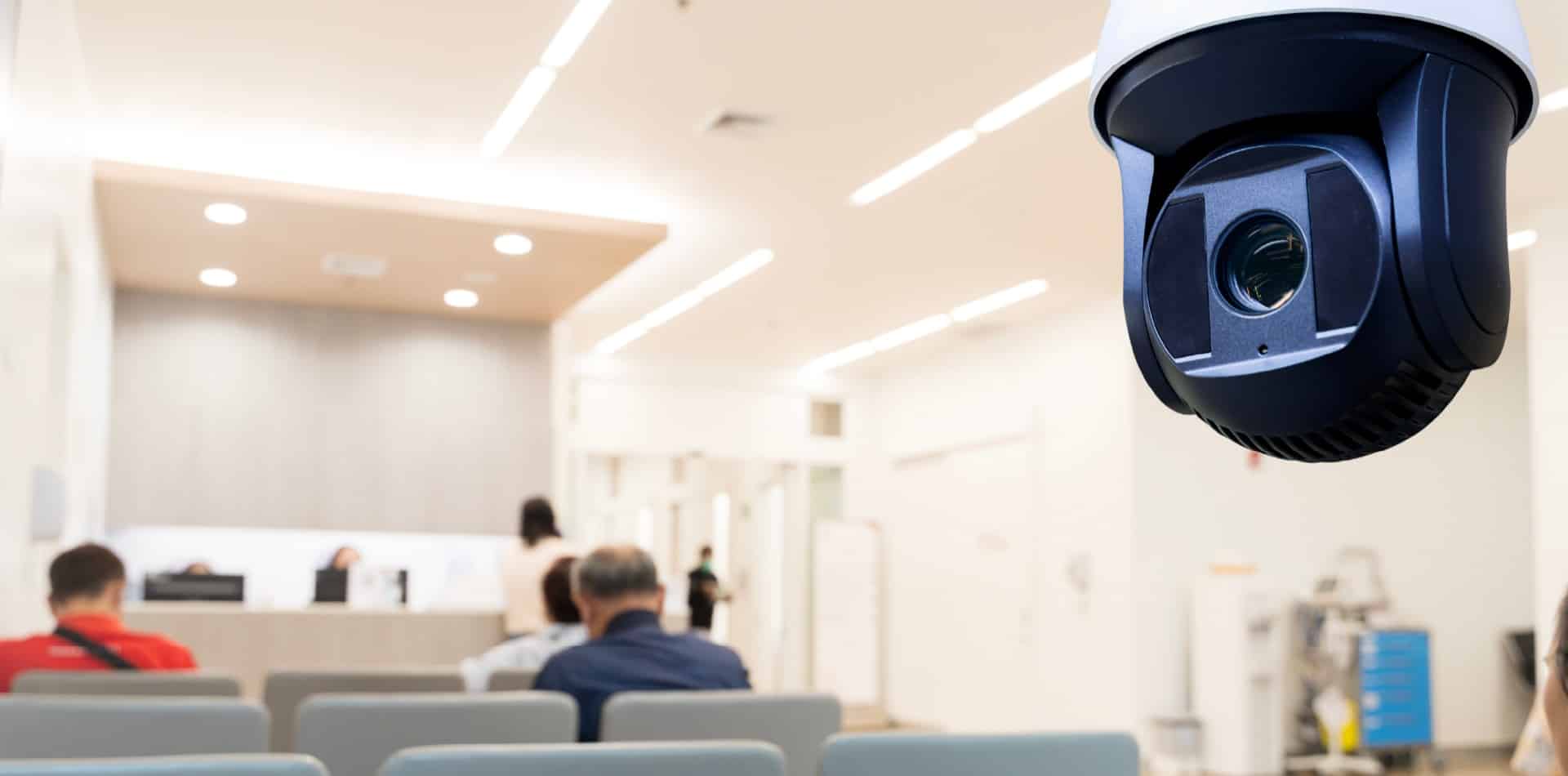
Security cameras are standard in most commercial buildings. In healthcare facilities, they’re just as necessary, but the rules around where cameras go, how footage is stored, and who can access it are far more complex than in any other commercial setting.
Get the placement wrong and you’re not just dealing with a blind spot in your security coverage. You may be facing a HIPAA violation, a privacy complaint, or legal exposure under Florida law.
This guide covers the practical security camera considerations every hospital, clinic, assisted living community, and nursing home administrator in Tampa Bay should understand before deploying or expanding a video surveillance system, including what HIPAA actually requires, where Florida law creates specific obligations, and how to approach the increasingly complicated question of cameras in resident rooms.
Why Healthcare Facilities Are Different from Every Other Commercial Building
In a retail store or office building, a security camera records activity, deters theft, and documents incidents. In a healthcare setting, any camera that captures a patient’s face, records a treatment area, or picks up a clinical conversation is potentially capturing Protected Health Information (PHI).
Under HIPAA’s Security Rule, PHI in any form — including video — must be secured against unauthorized access, with strict controls over who can view it and audit logs tracking every access event. A healthcare surveillance system that doesn’t account for this from the design stage isn’t just a privacy risk. It’s a compliance liability that’s far more expensive to correct after installation than to get right from the start.
This doesn’t mean cameras are off-limits in clinical environments. Most hospitals and healthcare facilities across the U.S. rely heavily on video surveillance for safety, incident documentation, and compliance. But the system has to be designed correctly — and that starts with knowing where cameras belong and where they don’t.
Where Security Cameras Belong in Healthcare Facilities
There are clear areas in any healthcare facility where video surveillance is not only appropriate but recommended:
- Entrances and exits — Monitoring who enters and leaves is a basic security function and carries minimal privacy risk in publicly accessible areas. This includes main entrances, emergency department entries, and after-hours access points.
- Waiting rooms and reception areas — High-traffic areas where incidents are most likely to occur. Camera placement here is widely accepted, though angles should be evaluated to avoid capturing computer screens displaying patient records.
- Emergency department lobbies — EDs are among the highest-risk areas for workplace violence in any healthcare setting. The Joint Commission addressed this directly in Sentinel Event Alert #59, which identifies emergency departments and behavioral health settings as consistently high-risk environments for physical and verbal violence against healthcare workers.
- Pharmacies and medication dispensing areas — Cameras are standard here to document controlled substance access and support diversion investigations. Monitors displaying this footage should be restricted to authorized staff only.
- Parking lots, garages, and exterior perimeters — Outdoor coverage carries low HIPAA risk and high safety value, particularly for staff working night shifts or in facilities with histories of vehicle incidents or assaults.
- Stairwells, corridors, and loading docks — Areas that are difficult to monitor physically and remain vulnerable to unauthorized access or after-hours activity.
Where Cameras Don’t Belong — and Why It Matters
This is where facilities most commonly create compliance problems. The following areas should not have cameras, and in most cases cannot under HIPAA and Florida law:
- Exam rooms and treatment areas — Patients have a reasonable expectation of privacy during clinical encounters. Any recording that captures a patient’s face, condition, or clinical conversation constitutes PHI under HIPAA.
- Restrooms and changing areas — Prohibited under HIPAA and basic privacy law, without exception.
- Nursing stations with visible patient records — Even if the camera isn’t pointed at a patient, if it can capture a screen displaying PHI, that’s a compliance vulnerability. Camera angles and monitor placement need to be evaluated together, not separately.
- Private patient rooms (in most cases) — This one is more nuanced, particularly in nursing home and assisted living settings, which we address in the next section.
The Florida Nursing Home and Assisted Living Question
Cameras in nursing home and assisted living resident rooms are one of the most complicated areas in healthcare security — and one of the most emotionally charged. Families increasingly want cameras in their loved one’s room to monitor care quality. Some residents want them. Some don’t. Florida facilities are caught in the middle, and the legal landscape here is particularly unsettled.
Unlike states that have passed laws explicitly permitting resident-installed cameras under defined conditions, Florida has no enabling statute on this. There is no Florida law that clearly permits family members to install cameras in a resident’s room, and no law that clearly prohibits it. As of early 2025, Florida Senate Bill 64 was filed to address this gap, but has not passed. Until it does, facilities and families are operating in a legal gray area.
Key watchouts for Florida nursing home and assisted living operators:
- Audio recording carries the clearest legal risk. Florida Statute 934.03 requires all parties to a conversation to consent before it can be recorded. A camera with audio capability in a resident room could capture caregivers who haven’t consented — creating real wiretapping exposure. Silent video is a less settled question, but audio is not.
- Roommate consent is non-negotiable. A resident who agrees to a camera shares that room with another resident who may not. The second resident’s privacy rights don’t disappear because their roommate consented, and that exposure falls on the facility if it permits installation without addressing it.
- A written camera policy is not optional. Because Florida law is unsettled, facilities without a written policy on privately-installed devices have no framework for responding when a family makes the request — or installs a device without asking. A clear policy protects the facility and sets expectations for everyone.
- Competency and consent are separate questions. Even a resident who isn’t competent to make financial or medical decisions may retain the ability to consent or refuse video monitoring. This should be assessed individually.
The practical takeaway for Florida operators: get a written camera policy in place now, before the legislature acts or a family puts you in a position where you’re making decisions on the fly. That policy should address consent requirements, audio capability, roommate rights, footage access, and retention. Given how fast this area is moving, annual legal review is worth the cost.
HIPAA Compliance Goes Beyond Camera Placement
Camera placement is the most visible compliance issue in healthcare video surveillance — but it’s not the only one. A properly designed system also needs to address:
| Compliance Requirement | What It Means in Practice |
|---|---|
| Access controls on footage | Only authorized personnel can view recordings; unique login credentials required for audit trail |
| Encryption in transit and at rest | Video containing PHI must be encrypted whether stored locally or in the cloud |
| Monitor placement | Live feeds and playback should be visible only in restricted areas, not at open reception desks |
| Retention policies | Define how long footage is kept in writing and follow it consistently |
| Signage | HIPAA guidance and Joint Commission standards support notifying patients and staff that surveillance is in use |
| Privacy masking technology | Modern systems can automatically blur faces or obscure screens in specific camera views |
Privacy masking in particular is underutilized in healthcare settings. It allows facilities to maintain surveillance coverage in areas where some visibility is needed, without capturing identifiable patient information in every frame.
Start With a Risk Assessment, Not a Camera Count
The most common mistake healthcare facilities make is starting with hardware before working through the compliance and risk framework. HIPAA requires a formal risk analysis before implementing any system that touches PHI. That analysis should identify where privacy risks exist, which areas genuinely require surveillance, and what safeguards need to be built in from the start.
A security integrator with genuine healthcare experience should be part of that conversation early — not brought in after the cameras are already on the wall.
Camera placement decisions, system architecture, footage access controls, and documentation requirements all need to work together. Getting that right at the design stage is far less costly than correcting it afterward.
“Healthcare security is one area where I always tell clients: the camera is the easy part. What takes real expertise is designing the system around the environment, the compliance requirements, the patient flow, the staff access patterns. A system that creates a HIPAA problem isn’t a security system. It’s a liability.”— Charles Ragghianti, President, A Total Solution, Inc. NICET III Certified | 33+ Years in Commercial Security and Fire Protection
Frequently Asked Questions About Healthcare Facility Security Cameras
Q: Does HIPAA prohibit security cameras in hospitals?
No — HIPAA does not prohibit security cameras in healthcare facilities. It requires that any video surveillance capturing Protected Health Information be handled with appropriate safeguards, including access controls, encryption, and audit logging. Cameras in publicly accessible areas like lobbies and parking lots generally carry minimal HIPAA risk. Cameras in clinical areas require careful design and placement evaluation.
Q: Can a family member install a camera in a Florida nursing home resident’s room?
Florida has no law that explicitly permits or prohibits this, which puts facilities in a difficult position. The clearest legal risk involves audio recording — Florida Statute 934.03 requires all-party consent, meaning caregivers captured on audio may not have consented. Facilities should have a written policy addressing resident and family camera requests before the question arises.
Q: What are the penalties for a HIPAA violation involving video surveillance?
HIPAA penalties range from $100 to $50,000 per violation, with an annual cap of $1.9 million per violation category. The severity depends on whether the violation was due to willful neglect and whether it was corrected. A surveillance system that captures PHI without appropriate safeguards — even unintentionally — can constitute a reportable breach if the footage is accessed by unauthorized individuals.
Q: Do assisted living facilities in Florida need to follow HIPAA for security cameras?
HIPAA applies to covered entities — hospitals, clinics, and healthcare providers — and their business associates. Whether an assisted living facility qualifies as a covered entity depends on the services it provides and whether it transmits health information electronically. Many assisted living facilities do fall under HIPAA. Florida’s own privacy laws and licensing requirements under AHCA add additional layers regardless of HIPAA status.
Q: What should I look for in a security integrator for a healthcare facility?
Look for a contractor with documented experience in healthcare environments specifically — not just commercial security generally. They should understand HIPAA’s Security Rule, be familiar with Joint Commission and AHCA survey requirements, and be able to walk you through a risk assessment before recommending any hardware.
In Florida, verify that they hold a current license under Chapter 489 or Chapter 633 as appropriate for the scope of work.
Healthcare Security Systems in Tampa Bay — A Total Solution
A Total Solution has worked with healthcare facilities, assisted living communities, hospitals, and clinics across Tampa Bay since 1988. We understand that a compliant security system in a clinical environment is about more than hardware — it requires understanding the environment, the regulations, and the real risks your staff and patients face every day.
Whether you’re evaluating your current camera coverage, planning a new facility, navigating a Joint Commission or AHCA survey, or trying to establish a policy on resident-installed cameras, we’re equipped to help you work through it.
📞 Call us at (727) 942-1993 or schedule a consultation online.
Related Blogs
Wander Management and Elopement Prevention in Assisted Living: A Florida Facility Guide
For assisted living and memory care communities in Florida, wander management and elopement[…]
Charlie Ragghianti
16 Sep 2026
Nurse Call Systems for Assisted Living and Healthcare Facilities: Why Response Time and Reliability Matter
In an assisted living community or a healthcare facility, a nurse call system[…]

Joe Velez
23 Aug 2026
The Future of Nurse Call Systems: How Modern Technology Strengthens Safety and Care
Nurse call systems have evolved from basic signaling tools into sophisticated, intelligent platforms[…]